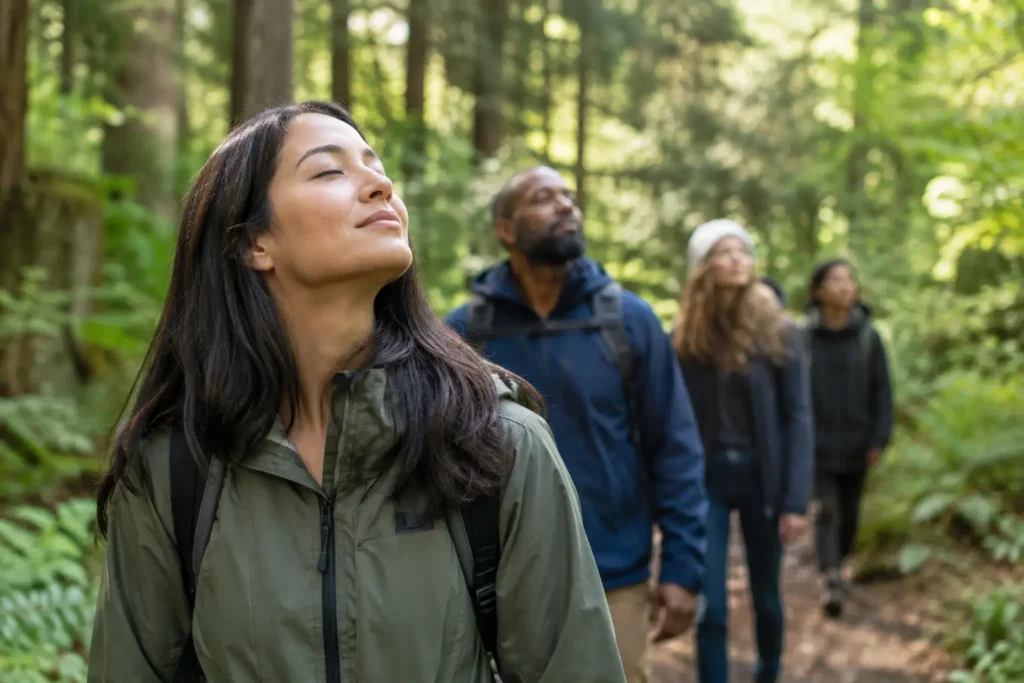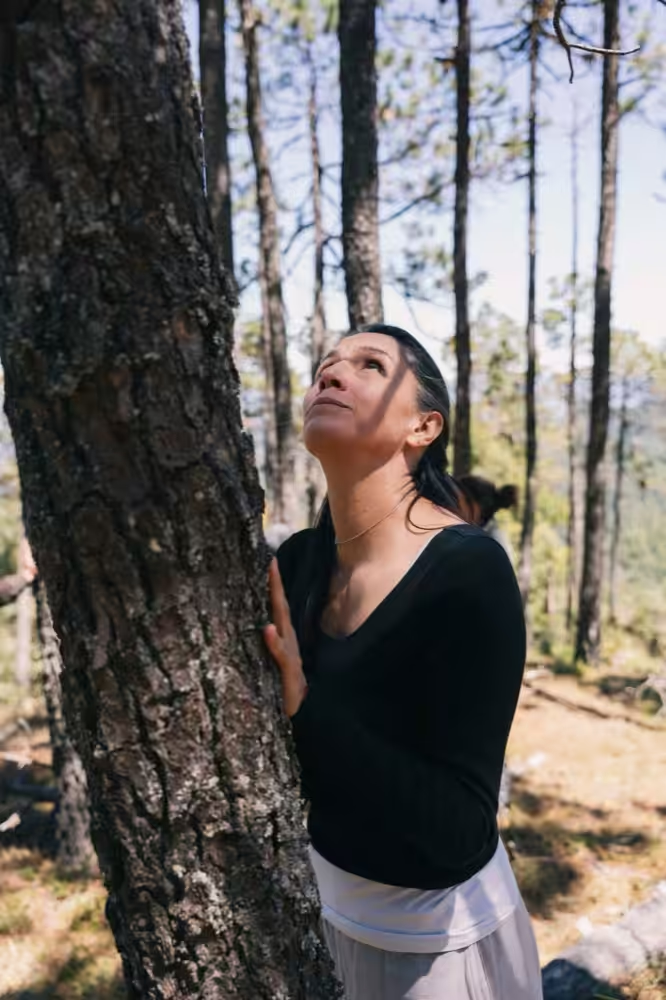

A park bench at lunchtime, a quiet trail before work, or the shade of one familiar tree can become a place to reset. Mindfulness in nature for beginners does not require a remote forest, special gear, or an hour of perfect stillness. It asks for something more accessible: a willingness to slow down long enough to notice what is already happening around and within you.
For many adults, time outdoors is still filled with productivity. We walk while answering messages, run while tracking pace, or take children and dogs out while planning the next task. A nature mindfulness practice creates a different kind of space. Rather than using nature as a backdrop, you allow the living world to become a gentle focus for your attention.
Why mindfulness outdoors can feel different
Mindfulness is the practice of noticing present-moment experience with openness and without immediately judging it. In a natural setting, your senses have more to work with: shifting light, birdsong, the texture of bark, moving air, and the rhythm of your own footsteps. These sensory details can make it easier to step out of repetitive thinking and into direct experience.
Research on time in natural environments suggests it can support stress reduction, emotional restoration, and attention recovery. That does not mean a walk outdoors is a cure for anxiety, burnout, or a health condition. It does mean that consistent, intentional contact with nature can be a meaningful part of a broader well-being practice, alongside appropriate professional care when needed.
Forest bathing, also known as Shinrin-Yoku, offers a useful framework. Despite the name, it is not exercise, hiking for distance, or literally bathing in the forest. It is a slow, sensory-led way of being with nature. The goal is not to achieve a particular mental state. The practice is to notice what changes when you give the natural world your unhurried attention.
Mindfulness in nature for beginners: choose a realistic place
The best location is the one you can return to. A large nature preserve may be inspiring, but a nearby greenway, botanical garden, neighborhood park, beach, or backyard is often more useful for building a sustainable habit. Familiar places also reveal something surprising over time: the same landscape is never exactly the same twice.
Choose a setting where you feel physically safe and reasonably comfortable. Consider weather, daylight, trail conditions, allergies, mobility needs, and local rules. If solitude makes you uneasy, bring a trusted companion and agree to spend part of the visit quietly, or select a well-used public space.
A forest can offer deeper immersion because its canopy, sounds, and biodiversity create a rich sensory environment. Still, beginners do not need to wait for the perfect wooded trail. Even a single tree can be an invitation to pause. Accessibility is not a lesser version of the practice. It is what makes the practice possible.
Start with ten unhurried minutes
Set aside ten minutes and leave the goal of “doing it right” behind. You can stand, sit, or walk very slowly. Before you begin, silence notifications or place your phone on airplane mode. If you need it for safety or navigation, keep it accessible but resist checking it.
First, arrive in your body. Feel the ground beneath your shoes or notice how your body is supported by a bench, rock, or patch of grass. Take two or three natural breaths. There is no need to force a deep inhale. Simply notice the breath you already have.
Next, let your attention move through the senses. Notice three colors or patterns in front of you. Listen for sounds close by, then farther away. Feel the temperature on your face, the firmness or softness underfoot, and the movement of air. If it is appropriate and safe, touch a leaf, a stone, or the ridged surface of a tree trunk. Let curiosity lead rather than trying to name every species or find a lesson in every detail.
Thoughts will keep arriving. That is normal. When you notice you are replaying a conversation or building tomorrow’s to-do list, gently acknowledge it and return to one sensory anchor. You might say quietly, “hearing,” “feeling,” or “seeing.” This is not a failure of concentration. Each return is the practice.
Try a slow sensory walk
If sitting still feels frustrating, a slow walk can be more approachable. Walk at a pace that allows you to notice the placement of each foot. Every few steps, pause. Let your gaze rest on something that naturally catches your attention: a branch moving in the wind, lichen on a rock, reflections on water.
Instead of asking, “What should I be getting from this?” try questions that have no correct answer. What is moving here? What is still? What sound has been present all along? What details would I miss if I hurried past? These questions invite attention without turning the experience into another task to complete.
You may feel calmer after ten minutes, but calm is not the only worthwhile outcome. Some days, nature makes you more aware of fatigue, grief, restlessness, or overstimulation. Meet that awareness with kindness. If your feelings become overwhelming, shorten the practice, return to a familiar place, or seek support from a qualified mental health professional.
Let go of the pressure to feel peaceful
Social media can make outdoor mindfulness look like a silent sunrise in an empty wilderness. Real practice is often less polished. A leaf blower may start halfway through. Mosquitoes may be persistent. Your mind may be busy. Rather than seeing these moments as interruptions, notice your response to them.
There is a practical trade-off between solitude and convenience, too. A quiet trail may offer fewer distractions, while a local park may be easier to visit three times a week. Frequency usually matters more than finding the most scenic destination. Begin with what fits your life, then expand as your confidence grows.
Avoid placing demands on nature or on yourself. You do not need to identify plants, meditate for a set number of minutes, or leave feeling transformed. The value is in developing a relationship of attention, respect, and reciprocity with the places that hold you.
Build a practice that lasts beyond one walk
Consistency grows when a practice has a clear cue. You might step outside after your morning coffee, spend ten quiet minutes in a park before entering the office, or take a technology-free walk after dinner twice a week. Keep the commitment modest enough that it feels supportive rather than demanding.
A simple reflection afterward can deepen the experience. Write down one thing you noticed, one sensation you felt, and one word for your current state. Over several weeks, this record can reveal patterns: which places restore you, what time of day feels most nourishing, and how your attention changes with the seasons.
As your practice develops, consider how you can care for the places that care for you. Stay on marked paths where appropriate, leave natural objects where they belong, carry out what you bring in, and respect wildlife. Mindfulness in nature includes awareness of our impact. A restorative relationship with the outdoors is also a responsible one.
When you are ready to go deeper
A personal practice can be enough. For others, the experience sparks a desire to learn the research, structure sessions for groups, or bring nature-based wellness into coaching, teaching, therapy-adjacent work, or retreat leadership. Professional forest bathing education offers a more intentional pathway, including ethics, facilitation skills, safety considerations, and the science behind nature connection.
Treeming.org provides accredited, self-paced Forest Bathing Guide Certification for people who want to build that knowledge with expert-led instruction. Formal training is particularly valuable when you plan to guide others, because a meaningful session requires more than asking people to take a walk outside.
The next time you pass a tree on your usual route, pause for one full breath. Notice its color, its shape, and the space it occupies. That small moment of attention is not an escape from your life. It is a way of returning to it with a little more presence.