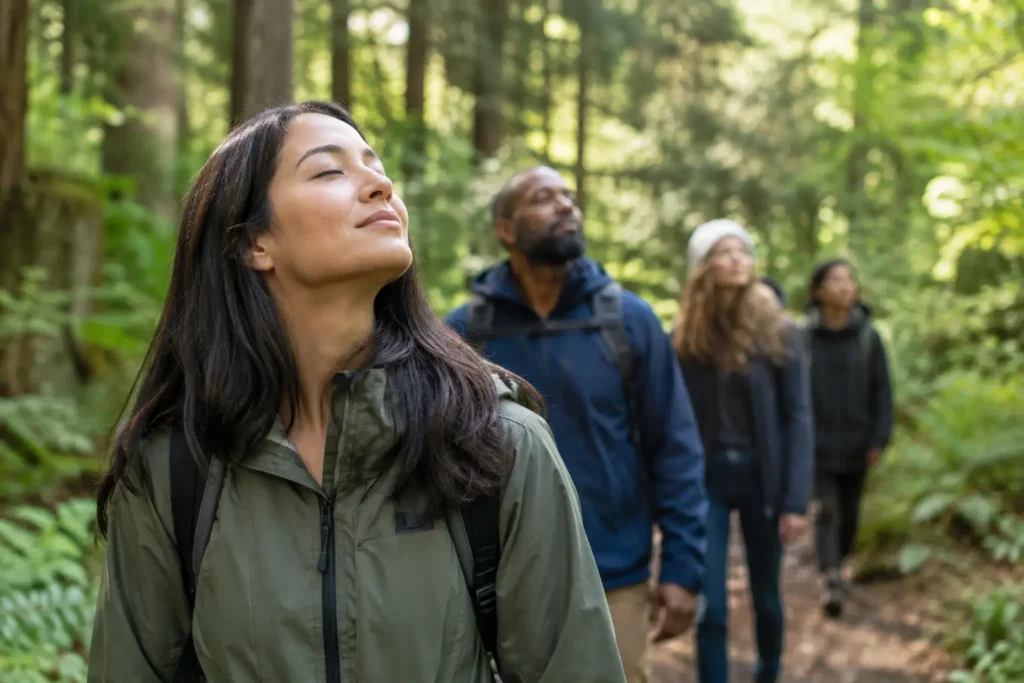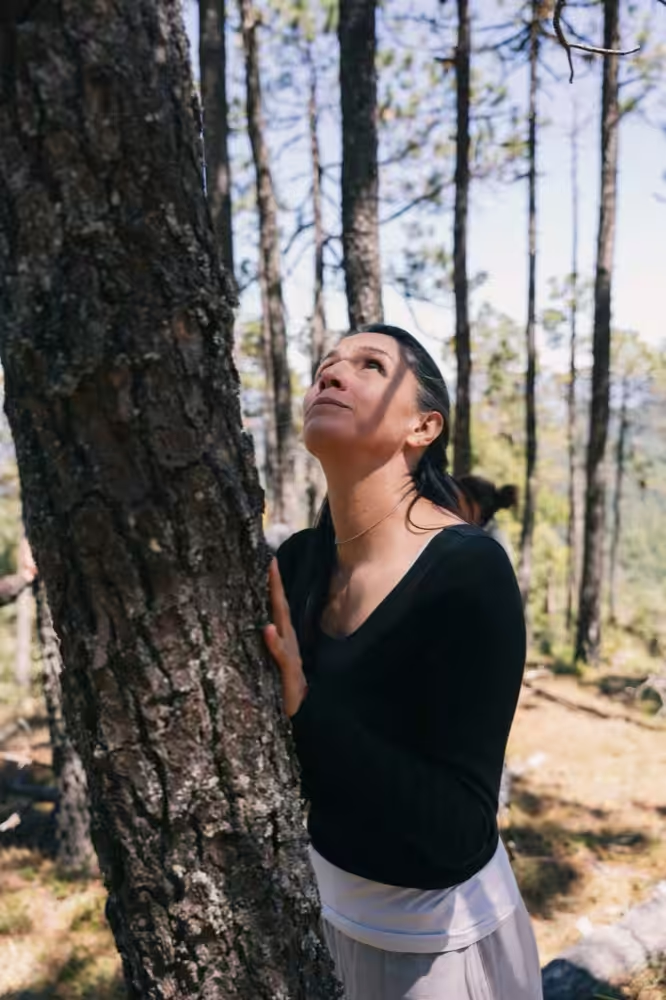

A forest bathing session outcomes client example is most useful when it shows the full picture: what a participant arrived carrying, what happened during the experience, what shifted afterward, and what did not. Forest bathing is not a performance or a medical treatment. It is a guided, sensory practice that creates conditions for rest, attention, and a more reciprocal relationship with the natural world.
For wellness professionals, the value of a client example is not in promising a dramatic transformation. It is in learning how to hold a well-designed session, notice meaningful feedback, and set grounded expectations. The following composite case is based on common participant experiences and does not represent one identifiable client.
A Forest Bathing Session Outcomes Client Example
“Maria” is a 38-year-old project manager who enrolled in a 90-minute guided forest bathing session at a local woodland preserve. Her work involved frequent deadlines, meetings, and extended time on screens. She described feeling mentally crowded, physically tense in her shoulders, and unable to fully transition out of work mode in the evening.
Maria was not seeking therapy, diagnosis, or a cure for stress. She wanted a structured way to spend time outdoors that felt more restorative than a fast-paced hike. Her guide explained this distinction before the session began: forest bathing is an invitation to slow down and relate to nature through the senses, not an exercise challenge or a substitute for clinical care.
The setting mattered. The trail was easy to walk, with mature trees, leaf cover, a small creek, and several quiet places to pause. Weather was mild, though occasional traffic noise could be heard from a distant road. A skilled guide does not wait for perfect wilderness. Instead, they help participants work with the place that is available while prioritizing safety, accessibility, and comfort.
Before the First Invitation
At the trailhead, Maria rated her present stress level as an 8 out of 10. This was her own informal check-in, not a clinical measurement. She said her thoughts were moving quickly and that she felt slightly guilty for taking time away from her responsibilities.
The guide began with practical orientation: the route, boundaries, restroom access, weather considerations, and permission to move at each person’s own pace. This opening is more than logistics. Clear expectations can help participants settle because they know they do not need to keep up, achieve a particular insight, or share more than they want to share.
The group was invited to silence notifications and move slowly for the first few minutes. Rather than explaining the benefits at length, the guide offered a simple sensory invitation: notice one thing that is moving and one thing that is still.
Maria later said this felt almost surprisingly difficult. Her attention initially kept returning to unfinished emails and a meeting scheduled for the next morning. That response was not a failure. It was useful information about how accustomed she had become to constant mental urgency.
What Happened During the Session
The session included several short invitations, each followed by unhurried solo wandering and a chance to gather as a group. The guide invited participants to notice the textures of bark, the variation of green along the forest floor, the temperature of the air on different parts of the body, and the sounds that emerged when they stood still.
About halfway through the session, Maria chose a place near the creek and sat on a portable sit pad. She noticed birdsong, moving water, and the rhythm of her own breathing. She did not report an immediate sense of peace. Instead, she first noticed fatigue.
This is a valuable lesson for guides and clients alike. When external stimulation decreases, people may become more aware of tiredness, sadness, restlessness, or tension that was already present. Forest bathing can create space to notice what is there. That is different from guaranteeing that every difficult feeling will disappear.
After several minutes, Maria described feeling “less pulled in five directions.” At the end of the invitation, she shared a simple image with the group: a curled fern slowly opening. The guide received the sharing without interpreting it or assigning it a meaning. In forest bathing, participants are the authority on their own experience.
The final portion of the session included tea made from a familiar, safely sourced plant and a quiet closing circle. The guide asked what each person wanted to carry into the rest of the day. Maria said she wanted to carry “slower transitions” between work and home.
The Outcomes Maria Reported
Immediately after the session, Maria rated her stress as a 4 out of 10. She said her shoulders felt less lifted, her breathing felt deeper, and her thoughts seemed less urgent. She also reported that the slow pacing gave her a clear contrast to her usual outdoor walks, which were often treated as another task to complete.
Later that evening, she sent the guide a brief follow-up message. She had not experienced a sudden solution to her workload, but she noticed that she did not reach for her phone as quickly after arriving home. She spent ten minutes sitting on her apartment balcony before making dinner. For her, that small pause felt practical and repeatable.
One week later, Maria reported taking two short “sensory breaks” outside during the workday. On one break, she stood under a tree near her office and listened for three distinct sounds before returning indoors. She said these moments did not remove her deadlines, but they helped her return to tasks with less agitation.
This outcome is modest, but it is meaningful. A successful forest bathing session may support a participant in recognizing their stress patterns, experiencing a temporary sense of calm, and building a nature-based practice they can continue. The most lasting result is often not an intense moment in the forest. It is a more available capacity to pause.
What Did Not Change After One Session
Maria still had a demanding job. She still experienced busy evenings and occasional trouble disengaging from work. Her session did not resolve workplace pressures, replace sleep, or address every source of anxiety in her life.
Naming these limits protects the integrity of the practice. Guides should avoid presenting forest bathing as a guaranteed cure for burnout, depression, trauma, or chronic health concerns. Participants who are managing significant mental or physical health challenges may benefit from forest bathing as part of a broader wellbeing plan, while continuing to work with qualified healthcare professionals when needed.
Outcomes also depend on context. One participant may leave feeling calm, while another feels emotionally tender or physically energized. Weather, group dynamics, mobility needs, sensory preferences, prior experiences in nature, and the guide’s pacing can all influence the session. There is no single correct response.
How Guides Can Assess Outcomes Ethically
For aspiring guides, the most credible approach is to collect simple, participant-led feedback without turning every session into a test. A brief arrival and departure check-in can reveal changes in mood, energy, stress, or sense of connection. Open questions are often more revealing than a score alone.
A guide might ask, “What are you noticing now that you were not noticing when we began?” or “Is there anything from this experience you would like to bring into your week?” These questions invite reflection without pressure. They also leave room for a participant to say that the session was challenging, neutral, or simply unfamiliar.
Written follow-up can be useful when it is optional and respectful of privacy. Over time, guides may notice themes across participants, such as improved ability to slow down, increased sensory awareness, or a desire to spend more intentional time outdoors. These observations can inform program design, but they should never be exaggerated into medical claims.
Professional training helps guides develop this balance of care, structure, and ethical communication. A globally recognized, accredited Forest Bathing Guide Certification, such as the training offered by Treeming.org, can help practitioners learn how to facilitate invitations, manage group safety, understand the science-informed context of the practice, and communicate outcomes responsibly.
A Better Measure of Success
Maria’s story is not remarkable because she became permanently stress-free after 90 minutes among trees. It is valuable because the session gave her a direct experience of another pace. She discovered that attention can be softened, that nature can be met without an agenda, and that a small ritual can travel home with her.
For clients and guides, that is a useful place to begin: not with the pressure to feel transformed, but with the permission to notice one quiet change and make room for it again.