
A well-chosen invitation can change the entire rhythm of a forest bathing session. When you create nature therapy invitations with care, you give participants permission to move beyond observation and into direct relationship with the living world. The goal is not to lead people toward a correct experience. It is to offer a gentle doorway into noticing what is already present.
For aspiring and practicing forest bathing guides, this is a skill worth developing deliberately. An invitation is where mindful presence, group care, and a science-informed understanding of stress reduction meet. It helps participants slow down, engage their senses, and find their own form of restoration outdoors.
What Makes a Nature Therapy Invitation Different?
A nature therapy invitation is not an instruction, a test, or a lesson disguised as a prompt. “Find five beautiful things” may direct attention, but it also creates a task to complete. An invitation, by contrast, leaves room for choice: “You are invited to wander slowly and notice what draws your attention. There is nothing you need to find.”
That distinction matters. Many adults arrive in nature carrying the habits of a busy life: achieving, planning, evaluating, and trying to get things right. Forest bathing offers a counterbalance. Spacious language helps the nervous system settle because participants are not being asked to perform mindfulness. They are being welcomed to experience nature at their own pace.
An effective invitation has a clear focus, but it does not predetermine an outcome. It may invite participants to listen, touch, notice movement, follow a sense of curiosity, or rest beside a tree. It also respects that every person brings a different body, history, ability level, and relationship with the outdoors.
Begin With the Site, Not Your Script
The strongest invitations are shaped by the place where you are guiding. Before a session, walk the route slowly. Notice where the soundscape changes, where sunlight lands, where the ground becomes uneven, and where participants might naturally pause. A moss-covered log, a quiet bend in the trail, or the first sound of wind in the canopy can each suggest a different invitation.
This preparation serves both presence and safety. If a trail has loose rocks, poison ivy, steep slopes, or limited seating, your invitation needs to work within those realities. The most poetic prompt is not useful if it encourages participants to move into an unsafe area or lose awareness of their footing.
Season also matters. In summer, an invitation around shade, coolness, and birdsong may feel natural. In winter, participants may connect more comfortably through stillness, breath, texture, or the contrast between bare branches and sky. Let the land lead. Nature therapy is not a fixed script repeated regardless of conditions.
Keep accessibility in the design
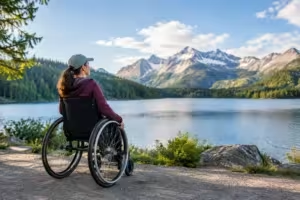
Choice is central to a welcoming invitation. Rather than asking everyone to walk off-trail or sit on the ground, offer options that work for a range of mobility needs. Participants might stand, sit on a portable seat, remain near the path, or explore within a clearly defined area.
You can also make sensory participation flexible. Some people may not want to close their eyes, touch unfamiliar plants, or move away from the group. Phrases such as “if that feels comfortable for you” and “you might choose” preserve autonomy without making the experience feel clinical or overexplained.
A Simple Framework to Create Nature Therapy Invitations
A practical invitation usually contains three elements: an orientation, an open exploration, and a gentle return. This structure gives participants enough clarity to feel supported while protecting the freedom that makes forest bathing restorative.
Start by orienting people to time and boundaries. Let them know how long they have, where they may wander, and how you will call them back. For example: “For the next 15 minutes, you are invited to explore this section of the trail at a pace that feels comfortable. Please remain between the trail marker and the large cedar. When you hear the chime, begin making your way back.”
Next, name one sensory or relational possibility. Keep the language short. “Notice the many forms of green around you, and see if one shade asks for your attention.” Or: “You are invited to find a place to pause and listen for sounds that feel near, far, or somewhere in between.”
Then make the invitation optional. A simple phrase such as “Take what serves you and leave the rest” reminds participants that their own experience is valid. This is particularly meaningful for people who are new to contemplative practices or who feel uneasy in unfamiliar natural settings.
Finally, close with an unhurried return. The transition back to the group is part of the practice. A chime, a familiar call, or a stated meeting point helps people reorient without abruptly breaking the calm they have found.
Use Language That Opens Rather Than Directs
Your words set the emotional temperature of the session. Nature therapy invitations tend to land best when they use sensory, present-tense language and avoid promises. You cannot guarantee that a participant will feel peaceful, inspired, or transformed. You can create conditions that support attention, rest, and connection.
Instead of saying, “This will help you release stress,” try, “Notice whether your body responds differently as you slow down.” This honors the well-established relationship between time in nature and stress reduction while allowing each person’s response to be their own.
Avoid language that assigns meaning to the landscape. A fallen branch is not necessarily a symbol of letting go, and a tree does not need to become a teacher for someone to benefit from being near it. Some participants may experience the forest spiritually; others may connect through ecology, sensory awareness, or simple quiet. A skilled guide makes room for all of these approaches.
Examples of spacious invitations
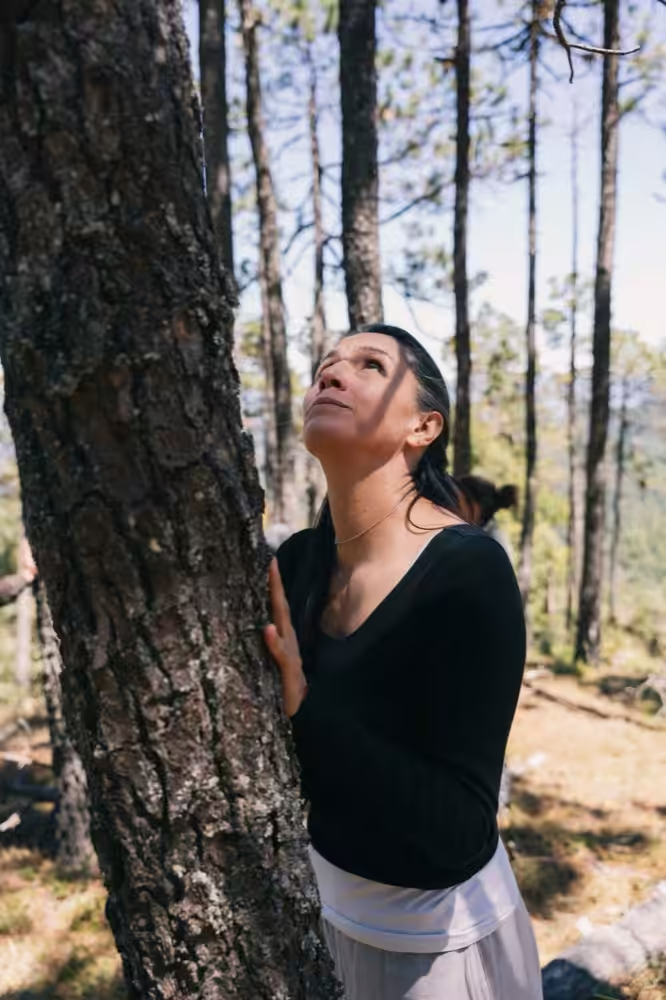
A tactile invitation might be: “If you would like, find a natural surface that feels safe to touch. Stay with the texture for a few breaths, noticing temperature, pattern, or pressure.”
For visual awareness, you could offer: “Let your eyes rest on the edge where one living thing meets another. There is no need to name what you see. Simply notice shapes, colors, and spaces.”
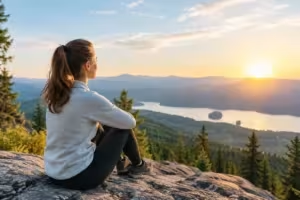
For a slower, more contemplative moment, try: “Find a place where you can be comfortably still. Notice what changes in the landscape when you stop moving.”
Each prompt is specific enough to begin an experience, yet open enough to allow the participant to decide what matters. That balance is the craft.
Plan for Sharing Without Forcing It
After an invitation, a circle of sharing gives participants a chance to witness one another and integrate what they noticed. It should never become a discussion where people analyze, advise, or compare experiences. A simple form such as “I noticed,” “I felt,” or “I was reminded of” can keep sharing rooted in personal experience.
As the guide, listen without interpreting. Silence is welcome. A participant may share a detailed observation about lichen, a moment of grief, or nothing at all. All are acceptable. The purpose is not disclosure. It is belonging.
For professional guides, this boundary is especially important. Forest bathing can support well-being, but it is not a substitute for mental health treatment or medical care. Clear scope, thoughtful group agreements, and appropriate referral practices protect both participants and the integrity of your work.
Refine Your Invitations Through Practice
Writing an invitation on paper is useful, but guiding it aloud reveals what needs to change. Read your prompts slowly. If a sentence feels too long to say in one calm breath, shorten it. If it contains several actions, choose one. Participants need time to experience the invitation, not memorize it.
After each session, reflect on what the group did rather than only what they said. Did they spread out naturally or remain close together? Did the timing feel generous? Were people confused about boundaries? These observations will help you improve your language and pacing over time.
Formal training can provide a valuable structure for this process. Treeming’s forest bathing guide certification emphasizes the foundations of facilitation, safety, and nature connection, helping future guides develop practices that are both restorative and professionally grounded.
The next time you stand at the edge of a trail with a group waiting, resist the urge to fill the silence with more words. Offer one clear, caring invitation, then let the forest and each participant’s attention do their quiet work.