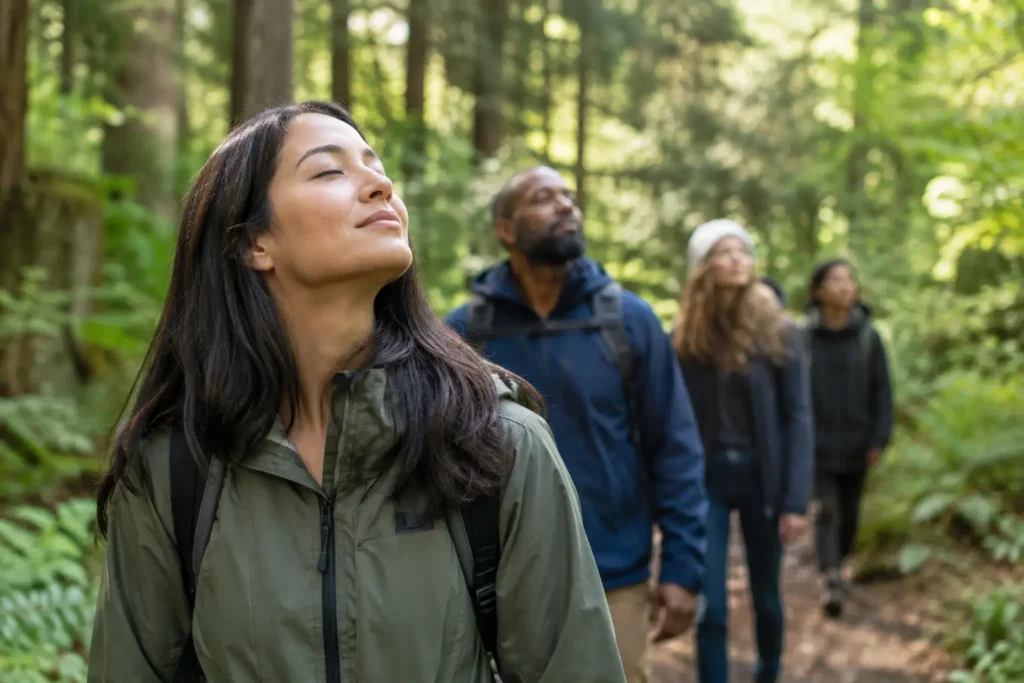

A woodland path can change the pace of a day before you have walked more than a few yards. The mindful walking in nature technique steps below turn an ordinary outdoor walk into a deliberate practice of sensory awareness, nervous-system restoration, and connection with the living world. You do not need to reach a viewpoint, log miles, or clear your mind completely. You only need enough time to notice what is already here.
Mindful walking in nature shares a spirit with forest bathing, or Shinrin-Yoku: an unhurried, receptive immersion in a natural setting. Research on time in green spaces suggests associations with lower stress, improved mood, and restored attention. The practice is not a replacement for medical or mental health care, but it can be a meaningful support for people who feel mentally crowded, physically tense, or disconnected from their surroundings.
Why Walking Slowly Changes the Experience
Most walks have an objective. We walk the dog, meet a step goal, get somewhere, or exercise with a particular pace in mind. Those are worthwhile reasons to move, yet they can keep attention fixed on the next task. Mindful walking asks a different question: What changes when there is nowhere else you need to be?
Slowing down gives your senses time to register subtle information: the temperature beneath the trees, the sound of leaves moving at different distances, the scent of damp soil after rain. This gentle sensory focus can interrupt habitual rumination without demanding that you force thoughts away. Thoughts may still arise. The practice is simply returning, again and again, to the body and the landscape.
Choose a place where you can feel reasonably safe and unhurried. A forest trail is wonderful, but a botanical garden, park, quiet shoreline, or tree-lined neighborhood can also work. The quality of attention matters more than finding a perfect wilderness setting.
Mindful Walking in Nature Technique Steps
Set aside 20 to 45 minutes if possible. Shorter walks still count, especially when practiced regularly. Leave your phone on silent or use it only for safety and navigation. Wear supportive shoes, bring water when conditions call for it, and check the forecast and trail conditions before you begin.
1. Arrive Before You Start Walking
Pause at the trailhead, park entrance, or first patch of green space. Stand comfortably with both feet on the ground. Notice the support beneath you, then take three natural breaths without trying to deepen or control them.
Let your eyes rest on one part of the landscape. It may be the line of a branch, a cluster of grasses, or light on a stone. This first pause marks a transition between doing and noticing. You are not trying to perform calmness. You are giving your attention a place to land.
2. Set a Light Intention
An intention provides direction without becoming another demand. You might choose curiosity, rest, gratitude, or simply the phrase, “I am here.” For a stressful day, an intention such as “I will move at a pace my body can trust” can be especially grounding.
Keep it simple. A mindful nature walk is not a test of whether you can be serene. If you arrive distracted, tired, or irritated, let that be part of your honest starting point. Nature-based mindfulness makes room for the experience you actually have.
3. Match Your Pace to Your Senses
Begin walking more slowly than usual. There is no correct speed, but you should be able to notice the shifting pressure from heel to foot to toe. Feel the ground’s texture through the soles of your shoes. Notice how your arms move and where your shoulders are holding tension.
If slow walking feels awkward or impractical on a busy trail, choose a moderate pace and periodically stop. The goal is not to move theatrically slowly. It is to make enough space for the senses to participate.
4. Open Your Awareness to Sound
For a minute or two, let sound lead the walk. First notice the most obvious sound, such as birdsong, wind, traffic in the distance, or water moving over rocks. Then listen for quieter layers beneath it.
Try not to label every sound immediately. Instead, notice its qualities: near or far, steady or intermittent, sharp or soft. This approach helps shift attention away from analysis and toward direct experience. In a city park, the contrast between natural and human-made sounds can become part of the practice rather than a failure of it.
5. Notice Light, Color, and Movement
Allow your gaze to soften. Rather than scanning ahead for what comes next, take in the broader visual field. Observe shades of green, the shape of shadows, patterns in bark, or the way a plant responds to a breeze.
This is not about identifying species, although curiosity about plants and wildlife can deepen your relationship with a place. It is about seeing with fewer assumptions. Even a familiar trail changes with the season, weather, and time of day. Let it be new again.
6. Invite the Other Senses In
Notice the air on your face and hands. If it feels appropriate, gently touch a leaf, rough bark, or smooth stone, taking care not to damage living plants or disturb habitat. Breathe in naturally and observe the scents present in the environment.
Taste is optional and should be approached carefully. Do not eat wild plants, berries, or mushrooms unless you have reliable expertise and permission to forage in that location. Mindfulness includes responsible judgment. Respecting the landscape is part of receiving its benefits.
7. Pause for a Moment of Connection
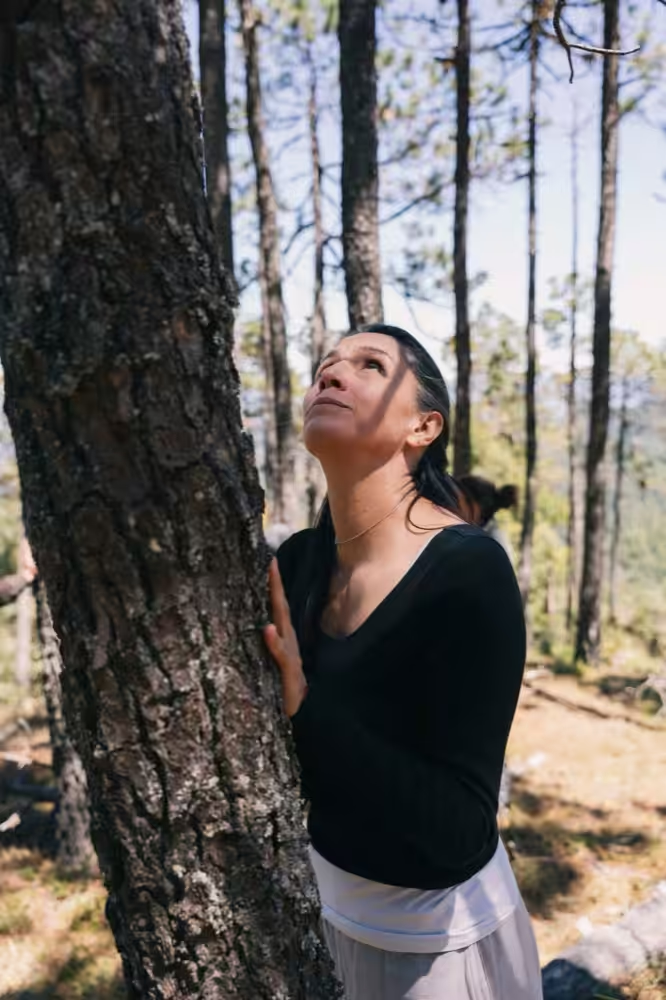
Near the end of the walk, find a place to stand or sit quietly for two to five minutes. Notice what has your attention now. Perhaps it is a single tree, the feeling of breath in the chest, or a sense of spaciousness that was not available when you arrived.
You do not need to manufacture a profound insight. Connection can be very ordinary: feeling your feet, hearing a bird call, recognizing that you are one small part of a larger living system. Before leaving, offer a silent thank-you to the place and consider one action that protects it, such as staying on the trail, carrying out litter, or supporting local conservation.
What to Do When Your Mind Wanders
Mind wandering is not a mistake. It is a predictable function of the mind, particularly when work pressures, caregiving responsibilities, or uncertainty are high. When you notice you have been planning, replaying a conversation, or checking your internal to-do list, acknowledge it without criticism.
Then return to one anchor: the sensation of walking, a sound, a color, or the next breath. This repetition is the training. Each return strengthens your ability to recognize where attention has gone and choose where it goes next.
For people who find silence uncomfortable, a gentle prompt can help. Ask yourself, “What is this place offering my senses right now?” Use the question once, then let the answer arrive through observation rather than effort.
Build a Practice That Fits Real Life
Consistency is more valuable than occasional perfection. A 15-minute mindful walk twice a week may have more practical impact than planning a monthly outing that never happens. Attach the practice to an existing part of your schedule, such as a lunch break, the end of the workday, or a weekend morning.
It also helps to vary the setting. A wooded trail may offer deeper sensory immersion, while a local park makes regular practice accessible. In cold, hot, or rainy weather, adjust the duration and clothing rather than abandoning the practice altogether. Safety, accessibility, and your body’s needs always come first.
If you are a coach, yoga teacher, therapist, or retreat facilitator, begin by practicing these steps yourself. Professional forest bathing guidance requires more than reading a script. It calls for careful pacing, ethical awareness, risk management, and the ability to create invitations rather than expectations. Accredited education, such as Treeming’s Forest Bathing Guide Certification, can help practitioners build those skills within a structured, science-informed framework.
The next time the day feels too fast, do not wait for a perfect destination or a free afternoon. Step outside, feel the ground beneath you, and let one unhurried stretch of path remind you that attention can be a form of rest.