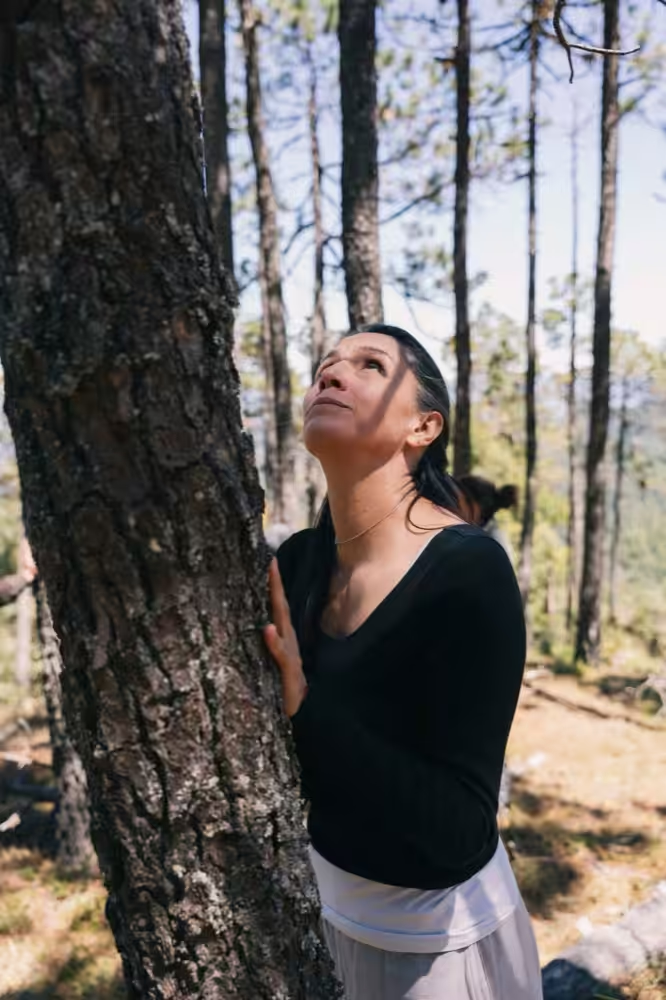

Grief does not move in a straight line, and it rarely asks for a solution. A thoughtful forest bathing for grief support session structure gives people something more appropriate: a calm container where they can slow down, notice what is present, and experience nature without pressure to explain or improve their pain.
For wellness professionals, the structure matters as much as the setting. Forest bathing can offer sensory grounding, spaciousness, and gentle human connection, but it is not psychotherapy or a substitute for clinical mental health care. A skilled guide holds clear boundaries, offers meaningful choice, and recognizes when someone needs support beyond the session.
Why grief needs a different kind of forest bathing session
A standard forest bathing walk may emphasize restoration, curiosity, and delight. Those elements can still belong in grief support, but they should not become a demand to feel better. Someone who is grieving may arrive numb, distracted, angry, tired, relieved, or unexpectedly joyful. All of those responses can be valid.
The guide’s role is not to interpret grief or lead participants toward a particular emotional outcome. It is to create conditions that support regulation and presence. The rustle of leaves, the feel of bark, changing light, birdsong, and the steady rhythm of walking can invite attention back to the body and the immediate moment. For some people, that experience feels comforting. For others, silence or sensory input may feel intense. Choice is what makes the practice supportive.
A grief-focused session should also move at a slower emotional pace. Avoid asking participants to share their story, name the person they lost, or locate a lesson in their grief. Invitations should be open enough for each person to decide what is safe to engage with.
Before the session: prepare the container
Good grief support begins before anyone steps onto the trail. Choose a familiar, accessible location with low risk, minimal traffic noise, nearby restrooms when possible, and a clear place to gather. A short route is usually better than a scenic but demanding one. Participants should never need to push through physical discomfort to keep up.
For a first-time group, 90 to 120 minutes is often a workable range. This allows enough time to settle without leaving people emotionally exposed in the woods for too long. Keep groups small, ideally four to eight participants, so every person can receive appropriate attention while still retaining privacy.
Your registration language should state the scope plainly. Explain that the session is a guided nature-based wellness experience, not group therapy, grief counseling, or crisis intervention. Invite participants to consult a qualified health professional if they are navigating acute distress, trauma symptoms, or thoughts of harming themselves. Have a simple emergency plan, local emergency contacts, and a clear protocol for weather, injury, and early departure.
It also helps to offer participants practical information in advance: terrain, expected weather, what to wear, whether there will be sitting or standing, and the permission to opt out of any invitation. Predictability lowers the threshold for participation, particularly when life already feels uncertain.
Forest bathing for grief support session structure
The following structure gives guides a reliable framework while leaving room to respond to the people and conditions in front of them. It is not a script. If the group needs more time to arrive, settle, or sit quietly, let the pace reflect that need.
1. Arrival and orientation: 10 to 15 minutes
Begin at the trailhead or another calm gathering point. Welcome everyone without requiring introductions. A simple name, if participants choose to offer one, is enough. Opening with a brief grounding practice can help signal that there is nowhere else to be.
You might invite the group to feel both feet on the ground, notice the temperature of the air, and take one unforced breath. Then establish agreements: participants may pass on any invitation, move at their own pace within the agreed area, step aside if they need space, and leave early if necessary. Remind the group that sharing is always optional.
This is also the moment to name the intention. Rather than promising healing, offer language such as: “We are here to spend time with the living world and to make room for whatever is true today.” That framing respects grief without centering it as a problem to solve.
2. Threshold crossing and sensory settling: 10 minutes
Walk slowly into the natural setting. A threshold can be as simple as pausing beside a large tree, at the edge of a meadow, or where the path becomes quieter. Invite participants to notice the transition from their day into this place.
Keep the first invitation concrete and sensory. Ask participants to find three colors, follow the movement of one branch in the wind, or notice where they feel supported by the ground. Sensory attention can be especially useful when grief pulls someone into mental replay, worry, or emotional overwhelm.
Avoid imagery that assumes nature is comforting. Instead of saying that the forest will hold everyone, ask what the place feels like to them today. One person may experience the forest as peaceful; another may feel restless. Both responses belong.
3. Gentle invitations and unhurried wandering: 25 to 35 minutes
This is the heart of the session. Offer two or three invitations with spacious intervals between them, allowing time for participants to wander, sit, lean against a tree, or simply stand still. The goal is not to cover distance. It is to deepen contact with the environment and with one’s own present-moment experience.
For grief support, invitations work best when they are observant rather than emotionally directive. A participant might be invited to notice something in the landscape that is changing, something that is enduring, or a place where life is quietly continuing. Another invitation might ask, “What is asking for your attention right now?” Participants can respond privately, through movement, or not at all.
Be cautious with prompts about letting go, closure, rebirth, or finding meaning. These themes may resonate for some people, but they can also feel premature or invalidating. A guide does not need to avoid depth. The practice simply needs to make room for each person to define it.
4. Rest, reflection, and optional sharing: 20 to 25 minutes
Gather in a comfortable circle, preferably with the option to sit or stand. Before inviting reflection, allow a minute or two of shared quiet. This helps participants transition from solitary noticing into connection.
A well-held sharing circle is not a discussion and not a place for advice. Offer a simple prompt, such as “What are you noticing?” or “Is there something from your time outside that you would like to name?” Participants may speak, pass, or offer a word, gesture, or silence.
As guide, receive each contribution without analysis. Avoid reassuring statements that try to soften pain, such as “Everything happens for a reason.” Acknowledgment is more supportive: “Thank you for sharing that,” or “We are listening.” If someone becomes tearful, do not rush to interrupt. Offer privacy, water, a quieter spot, or a co-facilitator’s support if available.
5. Closing and return: 10 to 15 minutes
Close with a clear transition back to ordinary life. Invite participants to notice one thing they will carry with them: a texture, sound, color, or small act of care they can offer themselves later. Keep this invitation light. The goal is continuity, not a grand declaration.
Thank the group for their presence, review practical next steps, and remind them to take their time before driving or reentering a busy schedule. If your session is part of an ongoing series, share the next meeting details without implying that participants must return to complete their healing.
What skilled guides watch for
Grief can become more visible in nature because the pace is slower and distractions are fewer. A participant may withdraw, become disoriented, panic, or share something that suggests immediate risk. Guides should be prepared to respond calmly, within scope, and without trying to become a clinician in the moment.
A simple approach is to orient the person to the present: invite feet on the ground, offer water, reduce stimulation, and ask whether they would prefer quiet, a brief walk with someone, or assistance contacting a support person. If there is concern about immediate safety, follow your emergency protocol. Do not leave the person alone.
Professional training strengthens this work because it teaches more than beautiful invitations. It develops facilitation judgment, ethical boundaries, group awareness, risk management, and an understanding of how to adapt a session without abandoning its purpose. For guides building a nature-based practice, accredited education can help turn compassionate instincts into responsible service.
A grief support session does not need to create a breakthrough to be meaningful. Sometimes the most restorative outcome is modest: a person notices the warmth of the sun, hears a bird beyond the noise in their mind, or remembers that they can be quiet beside others without having to carry everything alone.