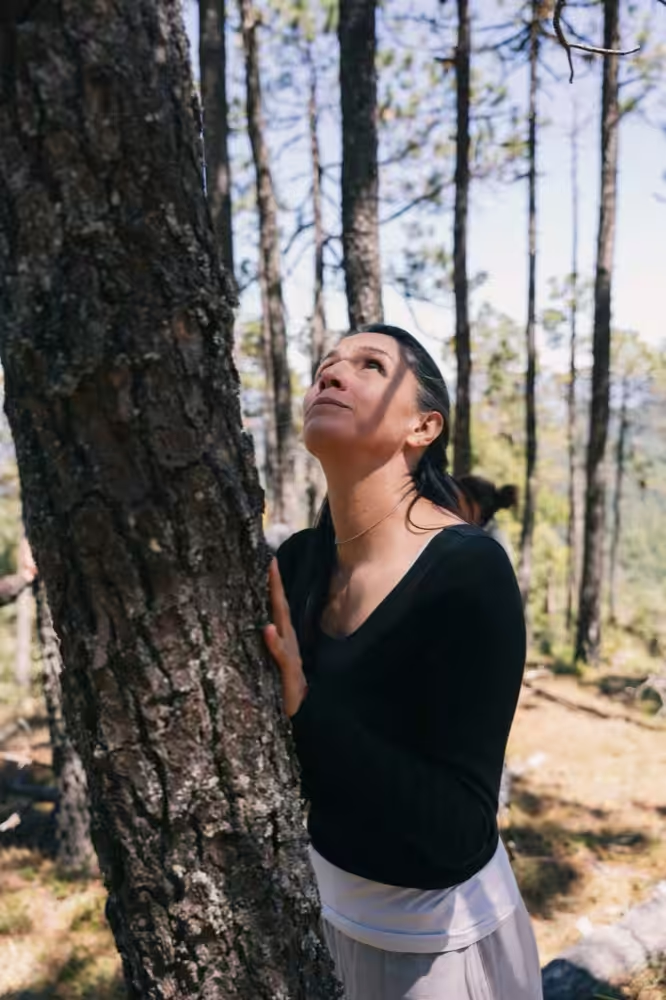

Some meditation scripts ask you to close your eyes and leave the world behind. A forest bathing guided meditation script does the opposite. It helps you arrive more fully in the living world around you – the movement of leaves, the texture of bark, the rhythm of your own breath – so your nervous system has a chance to settle in a way that feels grounded, sensory, and real.
That difference matters. Forest bathing, also known as Shinrin-Yoku, is not a hike, a workout, or a lesson in plant identification. It is a guided or personal practice of slow, mindful immersion in nature. Research continues to associate time in forest settings with reduced stress, improved mood, and greater mental clarity. A well-written script gives that experience shape. It creates enough structure to support calm, without turning the moment into another task to complete.
When to use a forest bathing guided meditation script
A script is especially useful when your mind feels noisy. Many adults who come to forest bathing are carrying cognitive overload, work fatigue, or a constant sense of urgency. In that state, even being surrounded by trees does not always lead to immediate relaxation. The body may still be braced for the next email, next obligation, next problem.
A guided script offers a bridge. It gently redirects attention from analysis to sensation. For personal practice, that can make nature immersion more consistent and more restorative. For wellness professionals, it can also improve the quality of a session by creating a clear beginning, middle, and close without sounding rigid or overly performative.
The trade-off is worth naming. A script should support presence, not dominate it. If you read every line word for word in a flat tone, participants may stay in their heads trying to follow instructions. The strongest forest bathing guidance feels spacious. It uses language carefully, then lets silence and the forest do much of the work.
What makes a good forest bathing guided meditation script
The best scripts are simple, sensory, and unhurried. They do not ask for dramatic emotional breakthroughs. They invite noticing. That might mean the temperature of the air on your skin, the scent of pine or damp soil, the subtle contrast between shadow and light, or the way your feet meet the ground.
Good scripts also respect pace. Forest bathing is slower than many people expect, especially those who are used to goal-oriented wellness practices. Slowness is part of the method. It gives the senses time to open and allows attention to shift from mental chatter toward embodied awareness.
Language matters too. Clear prompts such as notice, feel, listen, and allow are usually more effective than abstract phrases. If you guide others, keep your voice calm and grounded. You do not need to sound mystical to create a meaningful experience. In fact, many participants respond more deeply when the guidance feels both restorative and credible.
A forest bathing guided meditation script you can use
This script is designed for a short solo session or a guided group practice of about 10 to 15 minutes. Read it slowly. Leave pauses between lines. If you are guiding others, allow the environment to shape the timing.
Opening and arrival
Begin by finding a place where you can stand or sit comfortably.
Allow yourself to pause.
You do not need to achieve anything here. For these next few moments, simply let yourself arrive.
Feel the ground beneath you. Notice that it is holding your weight without effort.
Take one slow breath in through the nose.
And a gentle breath out.
Again, breathing in.
And breathing out.
Let your shoulders soften. Let your jaw unclench. Let your hands rest naturally.
If your mind is busy, that is okay. You do not need to stop your thoughts. Just let your attention begin to include the world around you.
Awakening the senses
Notice what you can hear first.
Perhaps there is birdsong, wind moving through branches, insects, distant water, or the quiet rustle of leaves.
There is no need to name every sound. Just receive them.
Now bring awareness to the air on your skin.
Is it cool or warm? Still or moving?
Notice any scent in the space around you. Earth, bark, rain, pine, grass, flowers, water.
Let yourself breathe naturally and take in what the forest is offering.
Now open your visual attention a little wider.
Without focusing too hard, notice shapes, patterns, and colors.
The vertical lines of trunks. The scatter of light. The movement of branches. The details you might usually pass by.
Allow your eyes to soften. Let seeing become less about identifying and more about receiving.
Rooting into the body
Bring your attention back to your feet.
Feel where your body meets the earth.
You might imagine roots extending downward, not as a fantasy to escape into, but as a way of sensing stability, contact, and support.
With each exhale, let your body give a little more weight to the ground.
With each inhale, receive the freshness of the air.
Notice your breathing as part of a larger exchange.
You breathe out. The trees receive.
The trees breathe out. You receive.
For a few moments, rest in that relationship.
Not separate. Not alone. Part of a living system.
Connecting with one element of the forest
Now let your attention be drawn to one natural presence nearby.
It may be a tree, a stone, a fern, a patch of moss, a fallen branch, or a place where light touches the ground.
Approach it slowly if you wish, or simply stay where you are and observe.
Notice its texture, color, shape, and form.
What stands out to you?
What changes when you give it your full attention?
If it feels comfortable, spend a moment in silent appreciation.
You do not need to force meaning. Just notice what it is like to be in relationship with this one part of the forest.
Resting in quiet awareness
Now widen your awareness again.
Sense the space around you.
Sense your body within that space.
Sense the forest not as a backdrop, but as a presence.
If thoughts arise, let them pass like leaves floating on water.
Return gently to sound.
Return gently to breath.
Return gently to the feeling of being here.
Let yourself rest for a few breaths in simple awareness.
Nothing to solve.
Nothing to prove.
Just this moment of contact.
Closing the practice
Begin to notice your body more fully again.
Wiggle your fingers or toes if that feels right.
Take one deeper breath in.
And slowly breathe out.
Before you leave, acknowledge whatever this moment has offered. It may be calm, clarity, gratitude, emotion, or simply a small reduction in internal noise.
Place a hand on your heart or your abdomen if you like.
Thank yourself for pausing.
And if it feels natural, offer quiet thanks to the forest as well.
When you are ready, continue your day with a slower step and a little more awareness than you had before.
How to adapt the script for personal or professional use
If you are practicing on your own, treat the script as a framework rather than a rulebook. You may want more silence, fewer words, or longer time with one sensory prompt. Some people respond best to sound-based awareness, while others settle more easily through touch, breath, or visual focus. It depends on your environment and your state of mind that day.
If you are guiding clients or groups, keep in mind that less is often more. People need time to feel the place for themselves. A common mistake among new guides is overexplaining the process or filling every silence. Trust the setting. Your role is to open the door and maintain psychological safety, not to narrate every second.
It is also wise to adjust for context. A dense forest, an urban park, a coastal grove, or a retreat setting will each shape the language differently. Accessibility matters too. Some participants may be standing, others seated, and others moving slowly along a short path. Strong guidance is inclusive, attentive, and responsive to the actual conditions of the practice.
Why script quality matters more than people think
A thoughtful script can change the experience from pleasant to genuinely regulating. That is not a small distinction. When guidance is too abstract, too rushed, or too crowded with instructions, participants may struggle to settle. When guidance is clear, spacious, and grounded in sensory awareness, the body often responds with more ease.
This is one reason professional training matters for those who want to lead others. Forest bathing may look simple from the outside, but skillful facilitation involves pacing, language, presence, ethics, and an understanding of how nature-based practices support well-being. For aspiring guides, a structured education can help bridge the gap between loving nature and confidently holding a meaningful session. Organizations such as Treeming.org have helped bring that level of accredited, science-backed training into an online format that fits modern life.
The forest does not ask for perfection. It asks for attention. If you use this script as a starting point, let it teach you something about your own pace, your own senses, and your own capacity to soften when the natural world is allowed to lead.