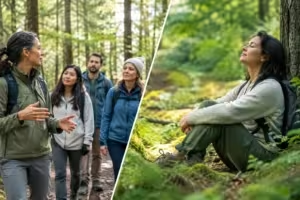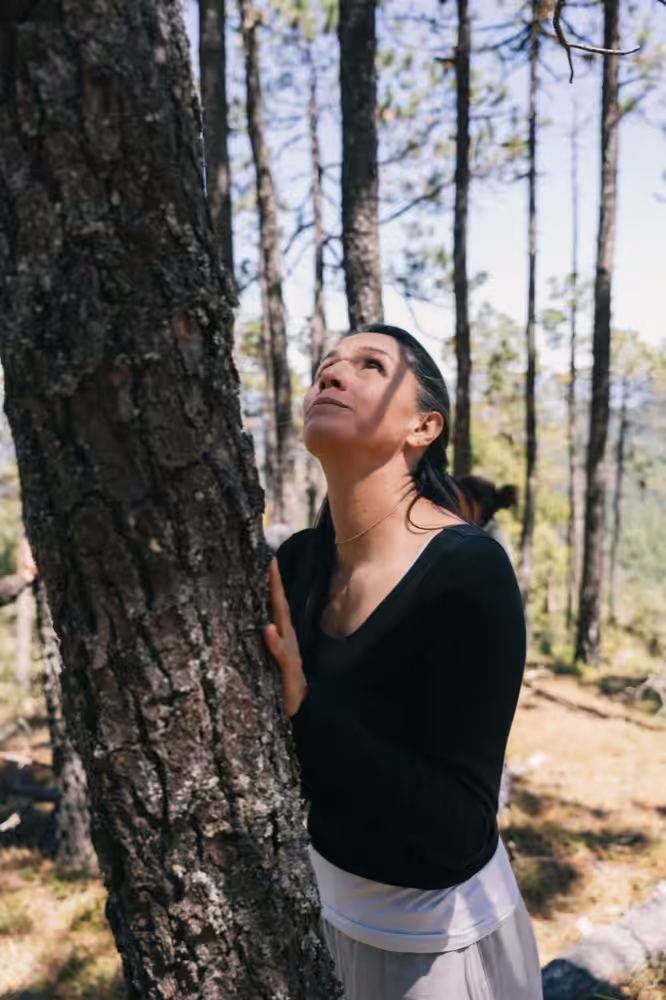
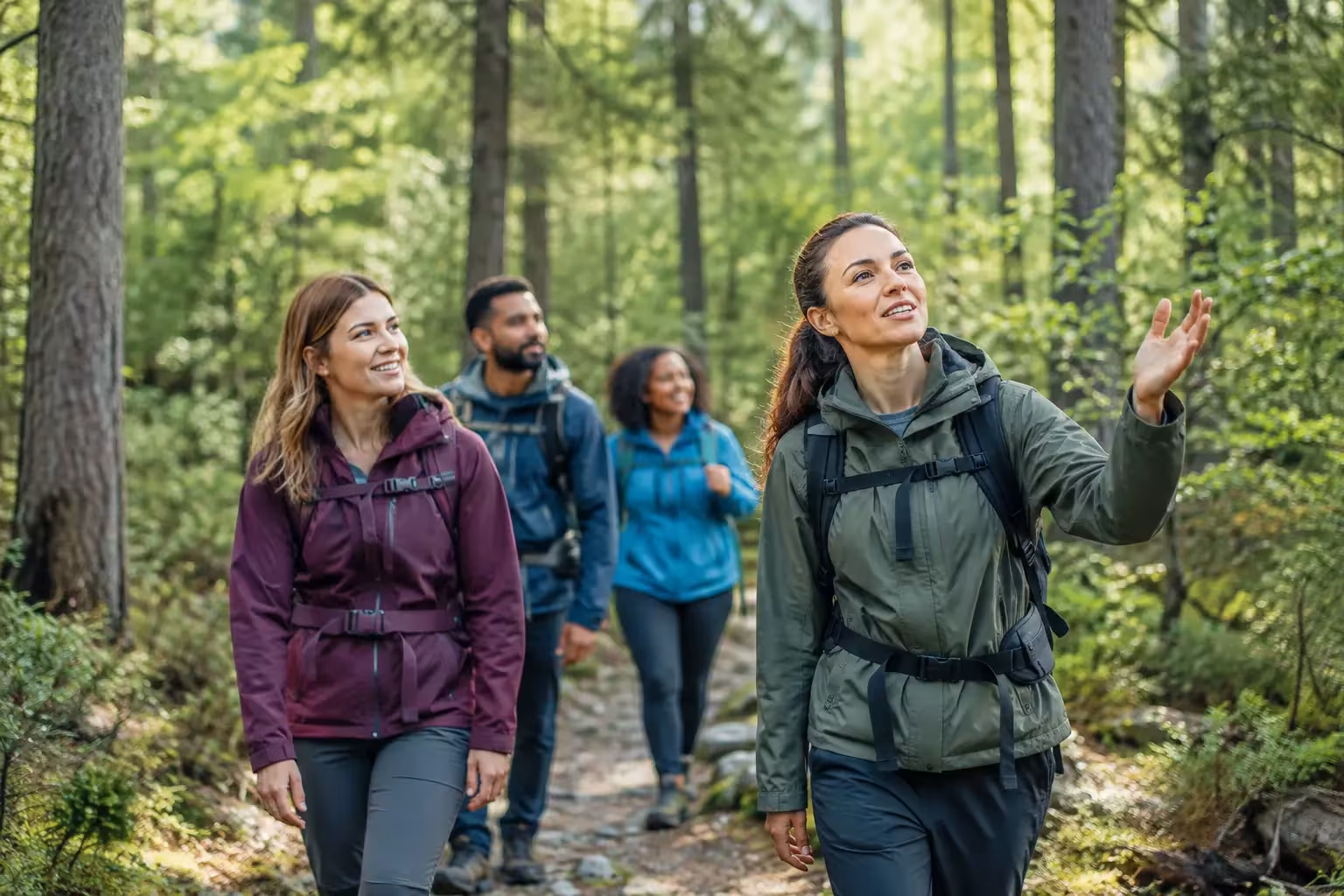
A well-held forest bathing walk rarely begins with walking. The most effective guided walk examples create a gentle transition from the pace of daily life into a slower, more receptive relationship with nature. For personal practice, that transition can bring a welcome sense of calm. For wellness professionals, it is the foundation of an experience that feels safe, intentional, and deeply restorative.
Forest bathing, also known as Shinrin-Yoku, is not a hike, a lecture on trees, or a fitness challenge. It is a mindful, sensory practice of being present in a natural setting. A guide’s role is not to tell participants what they should feel. It is to offer invitations that help each person notice what is already here.
What Makes a Guided Walk Different?
A guided walk has a clear container: an arrival, a sequence of invitations, periods of quiet exploration, opportunities to share, and a thoughtful closing. That structure matters because many people arrive carrying mental noise, deadlines, and the learned expectation that time outdoors must be productive.
The pace is deliberately unhurried. On a forest bathing walk, a few hundred yards may be enough. Rather than filling every moment with information, the guide uses concise prompts and leaves room for direct experience. Silence is not empty space to fix. It is often where participants begin to hear birdsong, feel the air against their skin, or recognize how quickly their attention has softened.
The examples below can be adapted for a solo practice, a small group, a retreat, or a professional session. Use them as frameworks rather than scripts. Weather, accessibility needs, group energy, cultural context, and the character of the site should always shape your choices.
Guided Walk Examples for Forest Bathing
1. The Arrival and Threshold Walk
This opening practice helps people arrive before they go farther into the landscape. Begin at a trailhead, garden entrance, or other clearly defined meeting point. Invite participants to stand comfortably and notice the support of the ground beneath their feet. A few slow breaths can be helpful, but avoid making breathwork feel like a performance or a test.
You might say: “Before we enter, notice what you are bringing with you. There is no need to change it. Simply acknowledge it, and let the forest know you have arrived.”
Then invite the group to cross an imagined threshold at their own pace. For the first several minutes, walk in silence. Ask participants to notice one detail that signals they have moved from an indoor mindset into an outdoor one: a shift in temperature, the texture of the path, an opening in the canopy, or a new sound.
This example works especially well for busy professionals or first-time participants. It gives permission to slow down without demanding instant relaxation. The trade-off is that it may feel simple to people expecting a more active agenda. That simplicity is precisely what makes it valuable.
2. The Five Senses Invitation
A sensory invitation is one of the most accessible guided walk examples because it gives attention a clear, manageable direction. Lead the group a short distance, then invite everyone to spread out where they can still remain safely within the agreed boundaries.
Offer one sense at a time. Begin with sight: “Find something in the forest you might have missed if you were moving quickly.” After a few minutes, move to sound: “Let sounds come to you. Notice those near and far, constant and changing.” Continue with touch, perhaps inviting participants to feel bark, a stone, a fallen leaf, or the air on their hands. If appropriate and safe, smell can follow. Taste should only be included when you have reliable knowledge of the setting and have not encouraged participants to consume plants.
The purpose is not to complete a checklist. It is to deepen contact with the present moment. Encourage curiosity over interpretation. Instead of asking, “What is that bird?” ask, “What changes when you listen without needing to name the sound?”
For guides, this practice is a reminder that precise language creates spaciousness. Keep each invitation short. Participants need time in relationship with the forest, not a continuous stream of instruction.
3. The Sit Spot and Nature Noticing Practice
Choose a safe, comfortable area where each participant can sit or stand alone for 10 to 20 minutes. The distance between people should allow privacy without causing anyone to feel isolated or unsafe. Before beginning, establish a simple signal for regrouping and make sure everyone understands the physical boundaries.
Offer the invitation: “Find a place that feels welcoming. Once you are there, let your attention rest on what is alive, moving, or changing around you. You do not need to search for anything extraordinary.”
A sit spot practice can reveal how much becomes visible when the body stops moving. A branch sways in a pattern. Light changes on moss. An insect travels over a surface that initially appeared still. These small encounters support a calmer, less effortful form of awareness.
This example is particularly useful in a multi-session program, when participants are ready for more quiet. For newcomers, a shorter period may feel more inviting. Some people become restless when asked to be still, especially if they are managing anxiety or are unfamiliar with contemplative practice. Normalize this response. Restlessness is also something to notice, not a sign that the practice is failing.
4. The Slow Wandering Invitation
Unlike a traditional group walk, slow wandering gives participants choice. Identify a contained area and invite them to move without a destination for a set amount of time. The instruction may be as simple as: “Allow something to gently draw your attention, then follow that curiosity at a pace that feels natural.”
This can be powerful because it returns agency to the participant. One person may be drawn to a sunlit clearing; another may remain beside a single fern. Neither response is more correct. The guide holds the time, safety, and boundaries while allowing the forest encounter to unfold personally.
For professional guides, this is also where site assessment matters. Avoid areas with unstable ground, steep drop-offs, poison ivy, or confusing trail junctions. Accessibility is equally important. A wandering invitation can happen on a paved path, in an arboretum, or beside a quiet urban tree canopy. Forest bathing is defined by quality of attention, not by remote wilderness.
5. The Shared Reflection Circle
After a period of individual practice, invite participants back into a circle. This is not a discussion group that asks people to analyze their experience. It is a chance to witness one another with respect.
A simple prompt could be: “If you would like to share, offer a word, image, gesture, or small piece of your experience.” Make it clear that passing is always welcome. When someone shares, receive it without interpreting, correcting, or turning it into a lesson.
In some traditions, the guide may respond with a brief acknowledgment such as, “Thank you,” or “We hear you.” The restraint is intentional. Participants often have enough advice in their lives. Being heard without being evaluated can be quietly meaningful.
Keep the circle proportionate to the group size. With a large group, invite concise offerings or pair sharing so the closing does not become rushed. With a smaller group, longer silences may naturally emerge. Both can be appropriate when held with confidence.
How to Build Your Own Guided Walk Sequence
A dependable session often moves from grounding to sensory awareness, then toward choice and reflection. Start with a welcome and practical orientation. Cover timing, physical boundaries, weather considerations, restroom access, and any site-specific safety needs before the contemplative portion begins. Clear expectations allow people to relax more fully.
Next, offer two or three invitations rather than trying to include every possible exercise. A 90-minute walk might include an arrival practice, a sensory exploration, a sit spot, and a closing circle. A two-hour session can hold more spaciousness between invitations. More activities do not automatically create a deeper experience.
Language should be invitational rather than commanding. Phrases such as “you may wish to notice,” “if it feels comfortable,” and “let yourself be curious about” honor individual experience. At the same time, calm leadership requires clarity. Participants should always know where to go, how long they have, and when they will return.
For those building a professional offering, accredited training can help translate this gentle practice into responsible facilitation. Treeming.org’s forest bathing guide certification emphasizes science-informed learning alongside practical guidance for leading nature-based wellness experiences. Credentials do not replace presence, but they can provide the structure, ethics, and confidence needed to serve others well.
A Few Practices to Avoid
Forest bathing can be simple, but it should never be careless. Do not pressure people to share personal emotions, promise medical outcomes, or frame nature as a cure for every challenge. Nature-based practices may support stress reduction and well-being, yet they are not a replacement for mental health or medical care.
Avoid overexplaining the landscape during the session. Ecological knowledge can enrich a walk when it is relevant, but constant facts may pull attention away from direct sensory experience. Also resist the urge to fill silence. A guide’s calm presence is often more valuable than another prompt.
Before every walk, consider the environment itself. Follow local regulations, stay on appropriate paths, minimize disturbance, and leave the site as you found it. Respect for the forest is part of the practice, not an extra step added at the end.
The strongest guided walk may be the one participants can carry home: a slower step beneath street trees, a pause beside a window, or five quiet minutes in a nearby park. When people learn that meaningful contact with nature does not require perfection or distance, the practice becomes easier to return to when they need it most.